

Aggregated Merchants API
Wave's Aggregated Merchants API provides a programmatic way to create, update, delete, and list aggregated merchant identities that are associated with your merchant account. An aggregated merchant identity allows you to interact with customers under a different name than your official account, and potentially with different fee structures. Once created, aggregated merchant identities can be used with the Checkout API and the Payout API.
Endpoints:
GET /v1/aggregated_merchants
POST /v1/aggregated_merchants
GET /v1/aggregated_merchants/:id
PUT /v1/aggregated_merchants/:id
DELETE /v1/aggregated_merchants/:id
Base URL
All the endpoint paths referenced in the API document are relative to a base URL, https://api.wave.com.
Authentication
Authenticating to the API is done via API keys. These keys are bound to a single business wallet and can only interact with it.
If you need to interact with more than one wallet in your network, then you will have to obtain one key per wallet.
Each request must be sent over HTTPS and contain an authorization header specifying the bearer scheme with the api key:
Authorization: Bearer wave_sn_prod_YhUNb9d...i4bA6
Note that the actual key is much longer but for documentation purposes most of the characters have been replaced by an ellipses.
Obtaining your API key
You can manage API keys in the developer's section in the Wave Business Portal. You can create, view, and revoke keys, and define which specific APIs each key has access to.
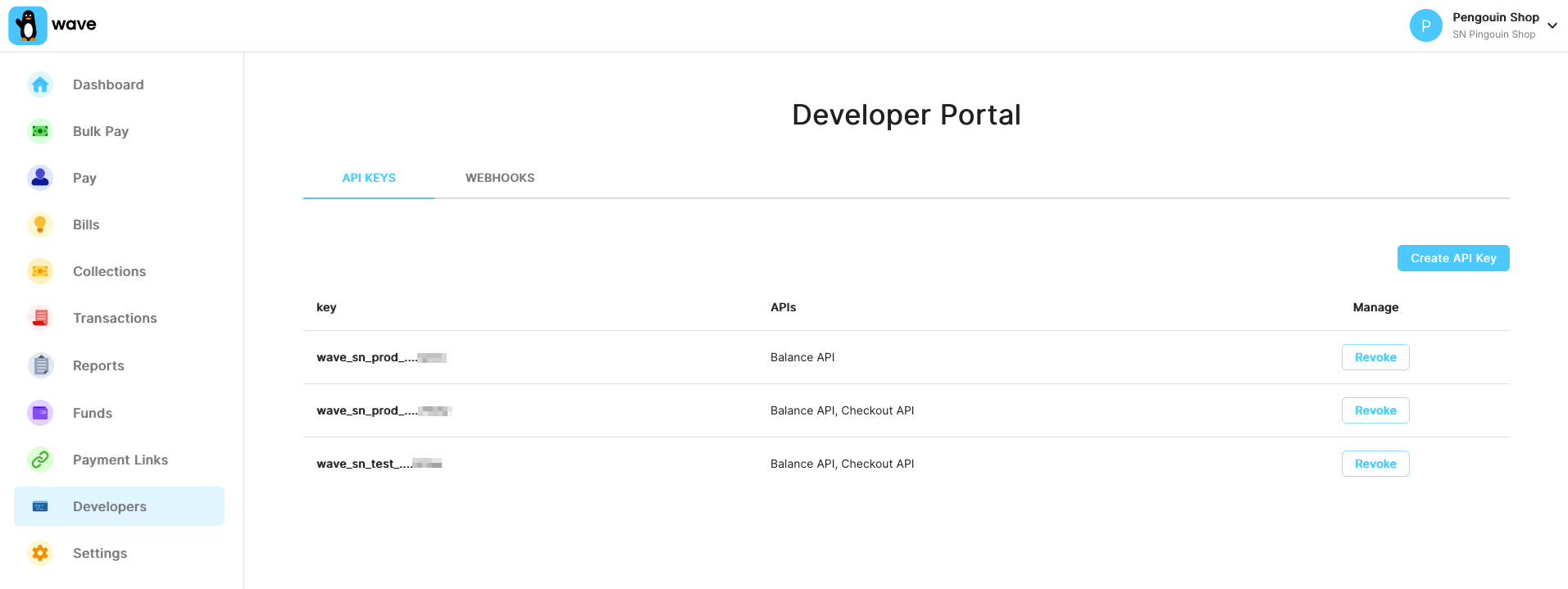
When you create a new API key, you will only see the full key once. Make sure you copy it without missing any characters, since it will be masked afterwards for security reasons.
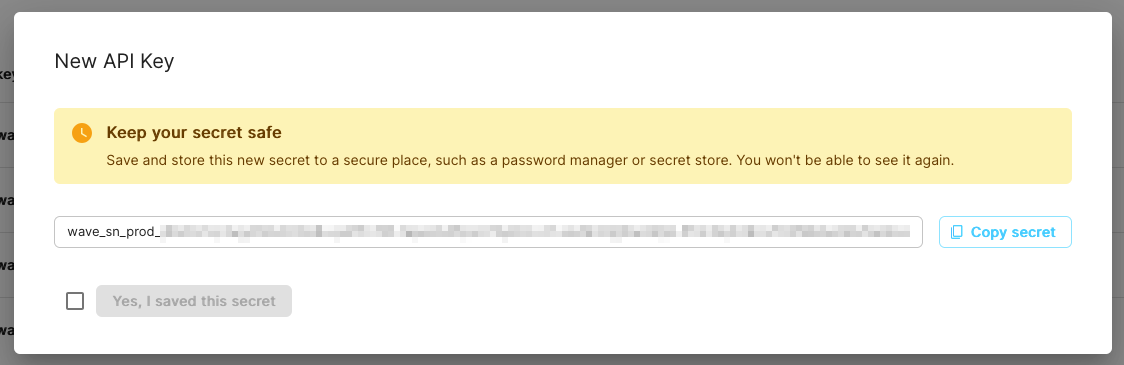
Wave doesn't know your full key, but if you contact API support we can identify them by the last 4 letters that you see displayed in the business portal.
Request signing
Request signing allows you to prove the integrity of your API requests. When enabled, each request must include a Wave-Signature header containing a timestamp and an HMAC-SHA256 signature of the request body.
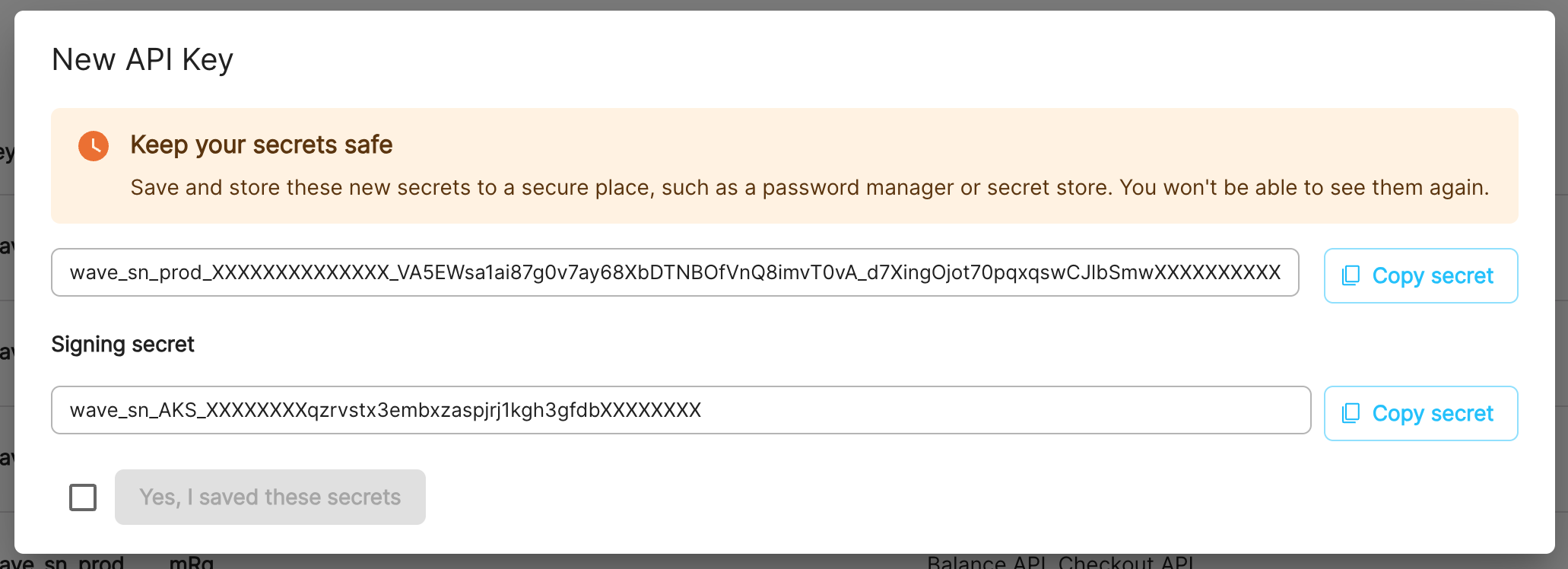
Request signing is optional. When you create an API key with request signing enabled, a signing secret is generated and shown to you once. After that, all requests made with that API key must include a valid Wave-Signature header.
Enabling request signing
When creating a new API key in the Wave Business Portal, select the option to enable request signing. You will receive a signing secret in the format:
wave_sn_AKS_XXXXXXXXXXXXXXXXXXXXXXXXXXXXXXXXXXXXXXXX
Constructing the signature
To sign a request, you must:
- Get the current time as a Unix timestamp (integer seconds).
- Construct the payload by concatenating the timestamp with the raw request body (i.e.
timestamp + body). - Compute the HMAC-SHA256 of the payload using your signing secret as the key.
- Set the
Wave-Signatureheader tot={timestamp},v1={signature}.
Example
Wave-Signatureheader:
Wave-Signature: t=1639081943,v1=942119aedf9fa377844cf010785fe14ef8478c72af0b73d62ea3941335b526a8
The Wave-Signature header consists of a timestamp prefixed by t= and a signature prefixed by v1=, separated by a comma.
Signature generation examples
# Generate the signature and make a signed request
TIMESTAMP=$(date +%s)
BODY='{"amount": "1000", "currency": "XOF"}'
SIGNING_SECRET="wave_sn_AKS_XXXXXXXXXXXXXXXXXXXXXXXXXXXXXXXXXXXXXXXX"

SIGNATURE=$(printf '%s%s' "$TIMESTAMP" "$BODY" \
  | openssl dgst -sha256 -hmac "$SIGNING_SECRET" \
  | sed 's/^.* //')

curl -X POST \
  -H "Authorization: Bearer wave_sn_prod_YhUNb9d...i4bA6" \
  -H "Wave-Signature: t=${TIMESTAMP},v1=${SIGNATURE}" \
  -H "Content-Type: application/json" \
  -d "$BODY" \
  https://api.wave.com/v1/checkout/sessions
Timestamp validation
Wave validates that the signature timestamp is recent to prevent replay attacks. Requests are rejected if:
- The timestamp is more than 5 minutes in the past.
- The timestamp is more than 30 seconds in the future (to allow for minor clock skew).
Ensure your server's clock is reasonably synchronized.
Signed request for GET endpoints
For GET requests that have no body, use an empty string as the body when constructing the signature payload. That is, the payload is just the timestamp string.
Error codes
In the authentication phase, one of the following errors can cause your request to return early:
| Status | Code | Descriptions |
|---|---|---|
| 401 | missing-auth-header |
Your request should include an HTTP auth header. |
| 401 | invalid-auth |
Your HTTP auth header can't be processed. |
| 401 | api-key-not-provided |
Your request should include an API key. |
| 401 | no-matching-api-key |
The key you provided doesn't exist in our system. |
| 401 | api-key-revoked |
Your API key has been revoked. |
| 401 | missing-signature |
Your API key has request signing enabled but the Wave-Signature header is missing. |
| 401 | invalid-signature-format |
The Wave-Signature header is malformed. It must be in the format t={timestamp},v1={signature}. |
| 401 | invalid-signature |
The signature does not match. Verify you are using the correct signing secret and signing the raw request body. |
| 401 | invalid-signature-timestamp |
The timestamp in the signature is not a valid number. |
| 401 | expired-signature-timestamp |
The signature timestamp is too far from the current time. |
| 403 | invalid-wallet |
Your wallet can't be used in this particular API. |
| 403 | disabled-wallet |
Your wallet has been temporarily disabled. You should still be able to use the endpoint to check your balance. |
Leaked API key remediation
If you suspect or have confirmed that a Wave Business API key has been exposed — for example, committed to a public repository, accidentally shared, or otherwise compromised — this page describes how to rotate it and what Wave will do in response.
What's at risk
Wave Business API keys authenticate requests to the Business APIs. Anyone who obtains a leaked key can call any endpoint the key has permissions for, including initiating transfers up to the available balance. Treat any exposure as urgent and rotate the compromised key immediately.
Rotate
- Sign in to the Wave Business Portal.
- In the developer section, generate a new API key with the same roles as the leaked one.
- Deploy the new key to your integration.
- Once the new key is in use, revoke the old one from the Business Portal.
See Obtaining your API key for more details on creating and managing keys.
If you can't access the Business Portal or aren't sure which API key has been compromised, contact your Wave account manager and we'll help.
What Wave does
When we learn of a leak, an account manager reaches out to the partner who owns the key with the leak details and rotation instructions. If we believe the leak is being actively exploited or we can't reach the partner, Wave may revoke the key directly to contain the exposure.
Preventing future leaks
- Use environment variables or a secrets manager — never commit keys to source control.
- Enable request signing on your API keys, so a leaked key alone can't be used to make requests.
- Configure IP whitelisting on your API keys so even a leaked key can't be used from an attacker's network.
IP Whitelisting
IP whitelisting restricts API access to requests originating from specific, pre-approved IP addresses. Even if an API key is compromised, requests from unrecognized IPs are rejected; adding a second layer of defense on top of key-based authentication.
This helps meet financial-services compliance requirements and gives internal teams tighter control over which servers can reach Wave's APIs.
How It Works
IP whitelisting works alongside API key authentication. When a request hits the API, three checks happen in order:
- API key validation: Is the API key valid?
- Enforcement check: Is IP whitelisting enabled for this wallet?
- IP validation: Does the request's source IP match an entry in the whitelist?
All three must pass for the request to succeed.
Configuration
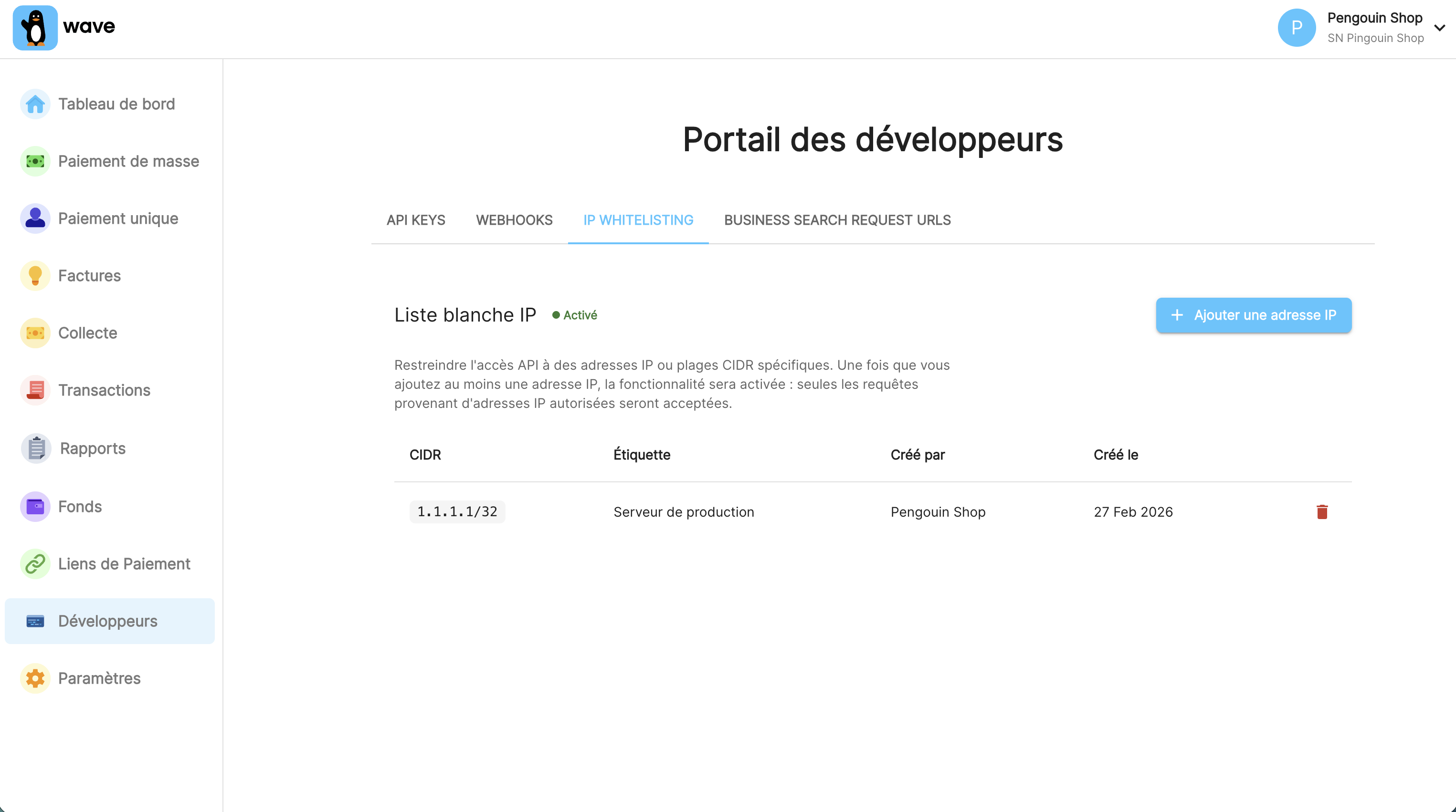
IP whitelisting is managed in the Wave Business Portal under the Developer section.
Supported Formats
You can whitelist a single IP or a CIDR range:
| Format | Example | Notes |
|---|---|---|
| Single IP | 203.0.113.45 |
Stored as /32 (IPv4) or /128 (IPv6) |
| CIDR range | 203.0.113.0/24 |
Whitelists an entire subnet |
Validation Rules
The system enforces the following constraints:
| Rule | Detail |
|---|---|
| Minimum prefix length | /8 for IPv4 (~16M addresses), /48 for IPv6 (standard site allocation) |
| No private/reserved IPs | Private, reserved, loopback and link-local addresses are rejected |
| No overlapping ranges | New entries must not overlap with existing whitelist entries |
| Normalization | All entries are normalized to strict CIDR notation |
Managing Entries
The portal lets you view all active whitelist entries, including labels and who created each one (created_by). Each entry should have a clear label describing the server, environment or purpose. This makes future audits much easier.
Error Handling
Requests from non-whitelisted IPs receive a 403 response:
| Status | Code | Description |
|---|---|---|
| 403 | ip-not-allowed |
The request originated from an IP address not on the allowlist |
{
  "error": {
    "code": "ip-not-allowed",
    "message": "Request from IP address (1.2.3.4) not in allowlist",
    "httpcode": 403
  }
}
Where possible, the IP address that the request originated from will be included in the error message. This can be used to check against the configured list of IP addresses in the portal.
Best Practices
Use static IPs. Dynamic IPs that rotate will break your integration. In cloud environments (AWS, GCP), use elastic or reserved IPs.
Keep ranges narrow. Whitelist only the specific IPs that need access. A single /32 per server is ideal; resort to broader ranges only when your infrastructure requires it.
Label everything. Include the server name, environment (staging/production) or purpose. Six months from now, an unlabelled entry is an entry nobody wants to touch.
Review regularly. Decommissioned servers and old test environments accumulate. Periodically audit the whitelist and remove stale entries.
Rate limiting
Wave APIs are rate limited to prevent abuse that would degrade performance for all users. If you send many requests in a short period of time, you may receive 429 error responses.
Types
Base types
Timestamp
An ISO 8601 date and time.
- The time zone is UTC.
- The precision is in seconds.
- The format is
YYYY-MM-DDThh:mm:ssZ. Example:2022-06-20T17:17:11Z.
Business Type
A string indicating the type of business an aggregated merchant engages in. This list may change. The following values are possible:
| Value | Description |
|---|---|
fintech |
A financial technology (fintech) company, as defined in your contractual relationship with Wave. |
other |
Any other type of company. |
Fee Structure
A string naming a fee structure. This list may change. The following values are possible:
| Value | Description |
|---|---|
one_percent |
1.00% fee. |
one_fifty_bps |
1.50% fee. |
Aggregated Merchant API request objects
Aggregated Merchant request
When creating or updating an Aggregated Merchant, a JSON object with the following fields is used:
| Key | Type | Description |
|---|---|---|
name |
String (up to 255 characters) | The name of this aggregated merchant. This is required to be unique. No two aggregated merchants can have the same name. |
business_registration_identifier |
String (optional, up to 255 characters) | Business registration information. |
business_sector |
String (optional, up to 255 characters) | Free-form text describing the business sector this aggregated merchant operates in. E.g., "agriculture", "finance", "education". |
business_type |
Business Type (required) | The type of business this aggregated merchant is asserted to be. Possible values are fintech or other. |
website_url |
String (optional, up to 2083 characters) | The website URL for this aggregated merchant. |
business_description |
String (required) | A description of the business. |
manager_name |
String (optional) | The name of the manager of the business. |
Aggregated Merchant API return objects
Aggregated Merchant response
After creating, or when retrieving an Aggregated Merchant, a JSON object with the following fields is returned:
| Key | Type | Description |
|---|---|---|
id |
String | A unique identifier for the Aggregated Merchant. Up to 20 characters. |
name |
String | The name of this aggregated merchant. |
business_registration_id |
String (optional, up to 255 characters) | Optional business registration information. |
business_sector |
String (optional, up to 255 characters) | Free-form text describing the business sector this aggregated merchant operates in. E.g., "agriculture", "finance", "education". |
business_type |
Business Type | The type of business this aggregated merchant is asserted to be. |
website_url |
String (optional, up to 2083 characters) | The website URL for this aggregated merchant. |
payout_fee_structure_name |
Fee Structure | The name of the fee structure this aggregated merchant uses for payouts. |
checkout_fee_structure_name |
Fee Structure | The name of the fee structure this aggregated merchant uses for checkouts. |
business_description |
String | A description of the business. |
manager_name |
String (optional) | The name of the manager of the business. |
is_locked |
Boolean | A flag indicating whether this aggregated merchant's attributes have been locked from further updates. An aggregated merchant can still be deleted if locked. |
when_created |
Timestamp | The time and date that this aggregated merchant was created. |
Paginated Aggregated Merchants response
A Paginated Aggregated Merchants is a paginated response containing a paginated list of aggregated merchants associated with an account.
| Key | Type | Description |
|---|---|---|
page_info |
Page Info | Pagination information. |
items |
List of Aggregated Merchant | A list of aggregated merchants. |
Aggregated Merchants Error response
Example
{
  "error_code": "not-found",
  "error_message": "Aggregated merchant not found."
}
Aggregated Merchants Error response is an object. If you send an invalid request, or a request that cannot be satisfied for normal reasons, you will receive an error object as a response. For some server errors (where the HTTP response code is 5xx or above), you may not receive a JSON response body.
| Key | Type | Explanation |
|---|---|---|
error_code |
String, an Error Code | One of a list of possible error codes. |
error_message |
String (optional) | An English description of the error that occurred. This message is subject to change. |
API
Retrieve a list of Aggregated Merchants
GET /v1/aggregated_merchants
curl -X GET \
  --url https://api.wave.com/v1/aggregated_merchants \
  -H 'Authorization: Bearer wave_sn_prod_YhUNb9d...i4bA6'
Example response
{
    "page_info": {
        "has_next_page": false,
        "end_cursor": "YzE6YW0tMWFrbjhkeWcwMTAwOA"
    },
    "items": [
        {
            "id": "am-7lks22ap113t4",
            "name": "Moustaphas Groceries",
            "business_sector": null,
            "business_type": "other",
            "business_registration_identifier": null,
            "website_url": "https://groceries.example.com",
            "payout_fee_structure_name": "one_percent",
            "checkout_fee_structure_name": "one_fifty_bps",
            "business_description": "A grocery store in the heart of the city.",
            "manager_name": "Moustapha",
            "when_created": "2022-06-21T09:56:29Z",
            "is_locked": true
        },
        {
            "id": "am-2rtmi4j8973vq",
            "name": "Fancy Fintech",
            "business_sector": "b2b services/integrations",
            "business_type": "fintech",
            "business_registration_identifier": "A-12234-M",
            "website_url": "https://fancy-fintech.example.com/",
            "payout_fee_structure_name": "one_fifty_bps",
            "checkout_fee_structure_name": "one_fifty_bps",
            "business_description": "A fintech company that provides payment solutions.",
            "manager_name": "Alice",
            "when_created": "2022-08-11T13:31:42Z",
            "is_locked": false
        }
    ]
}
Retrieves a paginated list of aggregated merchants available for use with the current account.
Query parameters
This endpoint accepts standard pagination query parameters.
Create an Aggregated Merchant
POST /v1/aggregated_merchants
curl -X POST \
  --url https://api.wave.com/v1/aggregated_merchants \
  -H 'Authorization: Bearer wave_sn_prod_YhUNb9d...i4bA6' \
  -H 'Content-Type: application/json' \
  -d '{
          "name": "Moustaphas Groceries",
          "business_sector": null,
          "business_type": "other",
          "business_registration_identifier": null,
          "website_url": "https://groceries.example.com",
          "manager_name": "Moustapha",
          "business_description": "A grocery store in the heart of the city.
      }'
Example response
{
    "id": "am-7lks22ap113t4",
    "name": "Moustaphas Groceries",
    "business_sector": null,
    "business_type": "other",
    "business_registration_identifier": null,
    "website_url": "https://groceries.example.com",
    "payout_fee_structure_name": "one_fifty_bps",
    "checkout_fee_structure_name": "one_fifty_bps",
    "business_description": "A grocery store in the heart of the city.",
    "manager_name": "Moustapha",
    "when_created": "2022-06-21T09:56:29Z",
    "is_locked": false
}
Creating an aggregated merchant makes it immediately available for use. The request body must be an Aggregated Merchant request object.
When creating an aggregated merchant, supply the most accurate information you can about the aggregated merchant in all fields, including:
- The business name
- The correct business registration identifier
- The business's website, if any
- The business's sector of operation
- The business type (either "fintech" or "other")
- The business manager's name
- A description of the business
When you provide correct and complete information, Wave can more effectively and quickly review aggregated merchants and choose appropriate fee structures.
Retrieve an Aggregated Merchant
GET /v1/aggregated_merchants/:id
curl -X GET \
  --url https://api.wave.com/v1/aggregated_merchants/am-7lks22ap113t4 \
  -H 'Authorization: Bearer wave_sn_prod_YhUNb9d...i4bA6'
Example response
{
    "id": "am-7lks22ap113t4",
    "name": "Moustaphas Groceries",
    "business_sector": null,
    "business_type": "other",
    "business_registration_identifier": null,
    "website_url": "https://example.com",
    "payout_fee_structure_name": "one_percent",
    "checkout_fee_structure_name": "one_fifty_bps",
    "manager_name": "Moustapha",
    "business_description": "A grocery store in the heart of the city.",
    "when_created": "2022-06-21T09:56:29Z",
    "is_locked": true
}
Retrieves the details of a single aggregated merchant. The response body will be an Aggregated Merchant response.
Update an Aggregated Merchant
PUT /v1/aggregated_merchants/:id
curl -X PUT \
  --url https://api.wave.com/v1/aggregated_merchants/am-7lks22ap113t4 \
  -H 'Authorization: Bearer wave_sn_prod_YhUNb9d...i4bA6' \
  -H 'Content-Type: application/json' \
  -d '{
          "name": "Moustaphas Candle Shop",
          "business_sector": null,
          "business_type": "other",
          "business_registration_identifier": null,
          "website_url": "https://example.com",
          "business_description": "A grocery store in the heart of the city.",
      }'
Example response
{
    "id": "am-7lks22ap113t4",
    "name": "Moustaphas Candle Shop",
    "business_sector": null,
    "business_type": "other",
    "business_registration_identifier": null,
    "website_url": "https://example.com",
    "payout_fee_structure_name": "one_percent",
    "checkout_fee_structure_name": "one_fifty_bps",
    "manager_name": "Moustapha",
    "business_description": "A grocery store in the heart of the city.",
    "when_created": "2022-06-21T09:56:29Z",
    "is_locked": true
}
Updates the details of a single aggregated merchant. The response body will be an Aggregated Merchant response.
After Wave has reviewed an aggregated merchant's details and set appropriate fee structures, an aggregated merchant will become locked from further updates. Attempting to update an aggregated merchant will fail with an HTTP 403 Forbidden response code. You may still delete a locked aggregated merchant.
Delete an Aggregated Merchant
DELETE /v1/aggregated_merchants/:id
curl -X DELETE \
  --url https://api.wave.com/v1/aggregated_merchants/am-7lks22ap113t4 \
  -H 'Authorization: Bearer wave_sn_prod_YhUNb9d...i4bA6' \
Example response
Expect an HTTP 204 response, with no response body.
Deletes a single aggregated merchant. You will no longer be able to use or update this aggregated merchant.
When successful, the server will return a HTTP 204 ("OK, no content") response. There will be no response body.
Pagination
Many of Wave's listing endpoints support pagination. If you are using a paginated endpoint, you must be prepared to accept paginated responses and continue making requests until no items remain or you have retrieved all of the data your application needs.
Paginated request
Paginated endpoints currently only support forward pagination. Backward pagination is not yet supported.
Example paginated request
curl -X GET \
  --url 'https://api.wave.com/v1/paginated-endpoint?first=10&after=YzE6YW0tMWFrbjhkeWcwMTAwOA'
For pagination, you may use the following query parameters:
| Parameter | Type | Description |
|---|---|---|
first |
Integer (optional) | The maximum number of items to retrieve. The server may respond with fewer items if your limit is too high, or if there aren't enough items remaining to fulfill the request. |
after |
String (optional) | An opaque cursor indicating where pagination should continue from. Typically you will use the value of page_info.end_cursor from the previous response. |
Paginated response
Example paginated response
{
    "page_info": {
        "has_next_page": true,
        "end_cursor": "YzE6YW0tMWFrbjhkeWcwMTAwOA"
    },
    "items": [
        {
            "id": "xyz-bm29dahzl",
            "name": "Item 1"
        }
    ]
}
A paginated response contains pagination information and a list of items. The specific item type is endpoint-dependent.
| Key | Type | Description |
|---|---|---|
page_info |
Page Info | Pagination information. |
items |
List of objects | A list of items. Item type varies by endpoint. |
Page Info object
The page info object contains information related to the current page of results, and a cursors that can be used to retrieve the next page.
| Key | Type | Description |
|---|---|---|
has_next_page |
Boolean | true if there is a next page after this one, false otherwise. |
end_cursor |
String | A cursor that can be used to fetch the next page of items. |
Example pagination request flow
Example initial request
curl -X GET \
  --url 'https://api.wave.com/v1/paginated-endpoint?first=10' \
  -H 'Authorization: Bearer wave_sn_prod_YhUNb9d...i4bA6'
Example initial response
{
    "page_info": {
        "has_next_page": true,
        "end_cursor": "YzE6YW0tMWFrbjhkeWcwMTAwOA"
    },
    "items": [
      ...
    ]
}
As an example, we can retrieve items from an endpoint, ten items at a time.
Note: The first query parameter is optional if we don't care about the precise number of items being retrieved. The server will choose a sensible default for the collection being retrieved.
Example next-page request
curl -X GET \
  --url 'https://api.wave.com/v1/paginated-endpoint?first=10&after=YzE6YW0tMWFrbjhkeWcwMTAwOA' \
  -H 'Authorization: Bearer wave_sn_prod_YhUNb9d...i4bA6'
Example next-page response
{
    "page_info": {
        "has_next_page": false,
        "end_cursor": "YzE6YW0tMWFrbjhkeWc6iNNoqP"
    },
    "items": [
      ...
    ]
}
When the response's page_info.has_next_page is true, more items remain to be retrieved. We can request another page of items using the page_info.end_cursor as our after query parameter.
Because this response has returned page_info.has_next_page as false, no items remain to be retrieved, and no further requests should be made. However, if page_info.has_next_page had been true, we could have again used the value of page_info.end_cursor as the value of our after query parameter to continue retrieving items.
Errors
Aggregated Merchants API errors
Example errors returned by the API
Permissions error
{
    "code": "no-permission",
    "message": "No permission to access this endpoint"
}
Validation error
{
    "code": "request-validation-error",
    "details": [
        {
            "ctx": { "limit_value": 255 },
            "loc": ["name"],
            "msg": "ensure this value has at most 255 characters",
            "type": "value_error.any_str.max_length"
        }
    ],
    "message": "Request invalid"
}
The following is the list of errors that can occur when using this API.
error_code |
explanation |
|---|---|
internal-server-error |
A technical error has occurred in Wave's system. We work very hard to avoid this, so it is only reserved for unexpected cases. Please get in touch with your Wave partner representative if you encounter this. If the endpoint supports idempotency keys, you can still retry the request automatically with the same idempotency key. We suggest you wait a couple of seconds between retries. |
missing-auth-header |
The request is missing a Bearer token in the Authorization header. See Authentication for instructions. |
no-permission |
The provided API is invalid, or does not have access to the requested API endpoint. |
not-found |
You requested an object that we can't find in our system, or that your account does not have access to. You should double-check that the ID corresponds to one that you've received in a response, and that the request came from the same business wallet. |
record-locked |
The aggregated merchant has been locked and cannot be modified. |
request-not-json |
Your request either doesn't have a JSON body, or is lacking the Content-Type header "application/json". |
request-parsing-error |
The JSON body of this request is invalid, generally because of misplaced brackets, commas, or quotes. The error_message will help you with details. |
request-validation-error |
Your request doesn't match the object type required. These are things like a missing field or an invalid type in a provided field like an invalid phone number. The error_message will help you with details. |
too-many-requests |
You've sent more requests than we can process in a short timespan. Some APIs support batch operations to reduce the likelihood of this occurring. |
duplicate-aggregated-merchant-name |
An aggregated merchant with the same name already exists. Aggregated merchant names must be unique. |
We suggest that you write code that can handle the errors above. We might occasionally add a new error type.
The list above only covers known errors that are within Wave's control. There could be other technical issues like connection errors or timeouts if there are any network issues between your servers and Wave's. These are too numerous to list, but in any of those cases, requests can be safely retried, as long as the same idempotency key is used on those endpoints that support idempotent requests.
HTTP Status Codes
The general reason for the failure is reflected in the HTTP response status code. 4xx codes signal a problem with the request from the client and 5xx codes indicate a problem on the server end. Specific details of the problem are provided in the message body.
Some of the status codes we return are listed below.
| Code | Title | Descriptions |
|---|---|---|
| 400 | Bad Request | The server cannot process the request because it is badly formed. |
| 401 | Unauthorized | The API key is invalid. |
| 403 | Forbidden | The API key doesn't have appropriate permissions for the request. |
| 404 | Not Found | You requested an object or page that could not be found. |
| 405 | Method Not Allowed | The combination of URL path and REST method doesn't exist on this API. |
| 408 | Request Timeout | The request took too long to process. Try again later. |
| 409 | Conflict | The request could not be completed due to a conflict with the current state of the resource. |
| 422 | Unprocessable Entity | The request was well-formed, but the server could not process it. |
| 429 | Too Many Requests | The rate limit was exceeded i.e. the server received too many requests in a given period of time. |
| 500 | Internal Server Error | The server encountered an error. Try again later, but the error may persist. |
| 503 | Service Unavailable | The server is unable to handle the request due to a temporary overload or scheduled maintenance. Try again later. |
| 504 | Gateway Timeout | A timeout occurred on the network while processing a request. Try again later. |
Changelog
2023-01-10
- Added
business_sector,business_type,website_url,payout_fee_structure, andcheckout_fee_structure. Updated examples. - Fixed some erroneous fields.
- Fixed the errors table.
2022-11-10
- Fixed a typo in the API URLs
2022-10-27
- Initial release